
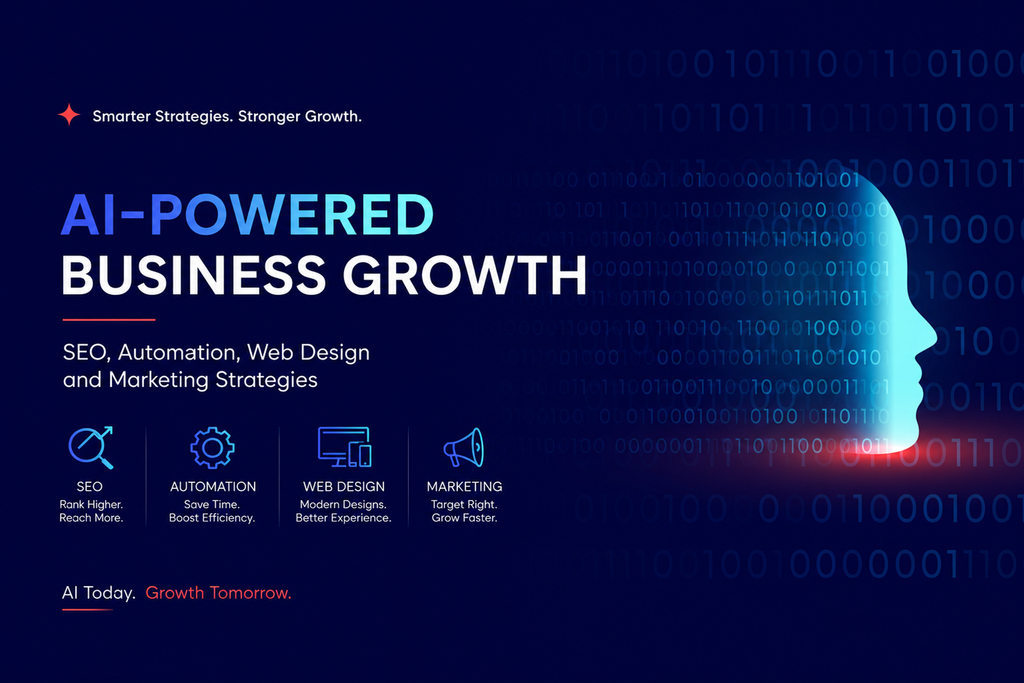
Artificial intelligence is changing the way businesses attract customers, build websites, manage daily operations, and compete online. What once seemed like technology reserved for large companies is now becoming accessible to startups, small businesses, agencies, and growing brands.
But simply adding an AI tool to your business does not automatically create growth.
The real opportunity comes from combining AI, SEO, automation, web design, and digital marketing into a strategy that makes the customer journey faster, simpler, and more effective.
In this article, we’ll explore how businesses can use AI-powered strategies to improve their online presence, generate better leads, automate repetitive work, and build long-term digital growth.
What Is AI-Powered Business Growth?
AI-powered business growth means using artificial intelligence and related technologies to improve different parts of a company’s operations and marketing.
Instead of replacing your existing business strategy, AI can strengthen it.
For example, a business could use AI to:
- Research customer interests
- Discover content opportunities
- Improve SEO
- Personalize website experiences
- Automate lead follow-ups
- Analyze marketing campaigns
- Generate content ideas
- Improve customer support
- Study website performance
- Assist sales teams
- Predict customer behavior
The important part is knowing where AI actually provides value.
A company doesn’t need to automate everything. It needs to identify the areas where technology can save time, improve customer experience, or increase revenue.
1. AI and SEO: A Smarter Approach to Search Visibility
Search engine optimization remains one of the most important ways for businesses to attract organic traffic.
However, modern SEO is no longer just about adding keywords to pages.
Search engines are becoming better at understanding context, intent, quality, and the overall usefulness of content.
This is where AI can support an effective SEO strategy.
AI can help businesses identify:
- Search topics
- Customer questions
- Content gaps
- Related keywords
- Search intent
- Competitor content patterns
- Internal linking opportunities
- Content optimization ideas
For example, instead of creating ten articles targeting almost identical keywords, AI-assisted research can help identify the broader questions customers are asking.
The result can be a more useful content strategy that covers a topic from multiple angles.
But Don’t Let AI Write Everything
One of the biggest mistakes businesses can make is publishing large amounts of generic AI-generated content without adding human expertise.
Customers want useful information, real experience, examples, opinions, and practical solutions.
AI can help with research and productivity, but human review is essential for creating content that feels authentic.
The best approach is simple:
Use AI for efficiency. Use human expertise for quality.
2. AI-Powered Web Design Is Changing Customer Experiences
Your website is often the first serious interaction a potential customer has with your business.
A slow, confusing, or outdated website can cause visitors to leave before they understand what you offer.
Modern web design is becoming more focused on user behavior, personalization, speed, accessibility, and conversion.
AI can support web design by helping businesses understand:
- Which pages visitors interact with
- Where users leave a website
- Which content attracts attention
- What products or services visitors prefer
- Which calls-to-action perform better
AI can also assist designers and developers with prototypes, content structures, user flows, and development workflows.
But good design still requires human judgment.
A website should not simply look impressive. It should make it easy for visitors to understand the business and take the next step.
3. Automation Can Turn Leads Into Opportunities
Imagine receiving a new lead through your website.
Without automation, someone may need to manually check the form, send an email, update a spreadsheet, contact the lead, and schedule a follow-up.
With a properly designed automation system, much of this process can happen automatically.
A simple workflow could look like this:
Website Form → Lead Captured → CRM Updated → Automated Email → Sales Notification → Follow-Up
This can save employees significant amounts of time.
Businesses can automate:
- Lead generation
- Email follow-ups
- Appointment reminders
- Customer onboarding
- Sales notifications
- Invoice reminders
- Review requests
- Social media workflows
- Customer support tasks
- Internal reports
The goal isn’t to remove the human element.
It’s to make sure employees aren’t spending their time on repetitive administrative tasks.
4. AI Can Improve Digital Marketing
Digital marketing is becoming increasingly data-driven.
Businesses now have access to information from websites, advertising platforms, social media, email campaigns, and customer interactions.
The challenge is understanding what the data actually means.
AI can help marketers identify patterns and generate insights from large amounts of information.
For example, AI can help determine:
- Which audience segments perform best
- Which campaigns generate quality leads
- Which content gets the most engagement
- Which landing pages convert visitors
- When customers are most active
- Which marketing channels deserve more investment
This can make digital marketing strategies more targeted and efficient.
Instead of spending the same amount of money across every channel, businesses can focus resources on the campaigns that actually contribute to growth.
5. Personalized Marketing Is Becoming More Important
Customers don’t want to feel like they’re receiving the same generic message as everyone else.
Personalization can make digital experiences more relevant.
For example, an e-commerce website could recommend products based on previous interactions.
A software company could show different content to new visitors and existing customers.
A marketing campaign could target different customer groups with different messages.
AI makes this type of personalization easier because it can process large amounts of customer and behavioral data.
However, businesses should use customer data responsibly and maintain transparency around privacy.
Personalization should improve the customer experience—not make customers uncomfortable.
6. AI Chatbots and Customer Support
Customer support is another area where AI can provide practical value.
AI-powered chat systems can answer common questions, guide visitors toward relevant information, and assist customers outside normal business hours.
For example, a website visitor might ask:
“What services do you provide?”
“How much does your website development package cost?”
“How long does a website project take?”
An AI assistant can provide immediate answers based on the company’s information.
More complicated requests can then be transferred to a human team member.
This creates a hybrid support model where AI handles repetitive questions while employees focus on more complex customer needs.
7. Content Marketing + AI: Quality Matters More Than Quantity
AI has made content creation faster, but faster doesn’t always mean better.
Publishing hundreds of low-quality articles will not necessarily create sustainable organic growth.
Instead, businesses should focus on creating content that answers real customer questions.
A strong content strategy can include:
- Educational blog posts
- Industry guides
- Case studies
- Tutorials
- FAQs
- Comparison articles
- Service pages
- Customer success stories
- Expert opinions
AI can help with research, outlines, brainstorming, and editing.
But businesses should add their own experience, examples, insights, and personality.
That’s what makes content feel human.
8. Conversion-Focused Web Design
Getting website traffic is only one part of digital growth.
The next question is:
What happens after visitors arrive?
A conversion-focused website should guide visitors toward a specific action.
Depending on the business, that action could be:
- Requesting a quotation
- Booking a consultation
- Purchasing a product
- Calling the business
- Sending an inquiry
- Signing up for a newsletter
- Starting a free trial
Good website design combines clear messaging, strong visual hierarchy, trust signals, fast loading speeds, and strategically placed calls-to-action.
AI analytics can then help identify where visitors are dropping out of the conversion journey.
9. AI Can Help Small Businesses Compete
AI isn’t only useful for large corporations.
Small businesses can also benefit from AI because many tools are now available through affordable software platforms.
A small company can use AI to assist with:
- Marketing
- Customer support
- Content creation
- Sales research
- Data analysis
- Administration
- Lead management
- Website optimization
This can allow smaller teams to accomplish work that previously required much larger departments.
For startups especially, this can be a significant competitive advantage.
10. Combining SEO, Web Design, Automation and Marketing
The real power comes from connecting these technologies.
Consider a simple example.
A company publishes a helpful SEO article.
A potential customer discovers it through search.
The visitor lands on a professionally designed website.
They see a relevant service and submit a form.
The lead is automatically added to the CRM.
An automated email confirms the inquiry.
The sales team receives a notification.
AI-assisted analytics later show which content generated the lead.
This is an integrated digital growth system.
Instead of treating SEO, web design, automation, and marketing as separate activities, businesses can make them work together.
11. How to Build an AI-Powered Growth Strategy
Businesses don’t need to transform everything overnight.
A practical approach is to start small.
Step 1: Identify Your Biggest Business Problem
Before choosing an AI tool, identify the problem you want to solve.
Are you struggling with leads?
Customer support?
Content creation?
Marketing analysis?
Repetitive administration?
Start there.
Step 2: Improve Your Website
Make sure your website communicates your value clearly and works well on mobile devices.
Speed, usability, security, and conversion should be priorities.
Step 3: Build an SEO Content Strategy
Create content around the questions and problems your target customers actually search for.
Focus on usefulness instead of keyword repetition.
Step 4: Automate Repetitive Work
Look for tasks that employees repeatedly perform and determine whether they can be automated safely.
Step 5: Use AI for Analysis
Once you have data, use AI tools to identify patterns and opportunities.
Step 6: Measure Business Results
Don’t measure success only through website traffic.
Track metrics such as:
- Qualified leads
- Conversion rate
- Customer acquisition cost
- Revenue
- Engagement
- Repeat customers
- Sales productivity
The objective is business growth—not simply more technology.
Common Mistakes Businesses Make With AI
AI can be powerful, but there are several common mistakes businesses should avoid.
Using AI Without a Strategy
Buying AI tools without knowing what problem they solve can increase costs without producing meaningful results.
Publishing Generic AI Content
AI-generated content without research, experience, or editing can feel repetitive and provide little value.
Automating Everything
Some customer interactions require empathy, judgment, and human communication.
Ignoring Data Security
Businesses should understand how tools handle customer and company data before integrating them into important workflows.
Focusing Only on Traffic
More website visitors don’t necessarily mean more customers.
Businesses should focus on qualified traffic and conversions.
Frequently Asked Questions
1. What is AI-powered business growth?
AI-powered business growth involves using artificial intelligence, automation, data, and digital tools to improve marketing, sales, customer service, operations, and overall business performance.
2. How can AI help with SEO?
AI can assist with keyword research, content planning, search-intent analysis, competitor research, content optimization, and identifying content opportunities. Human expertise should still guide the final content.
3. Can AI improve website design?
Yes. AI can assist with user research, content structures, personalization, analytics, testing, and development workflows. However, professional web design still requires human creativity and strategic thinking.
4. What business processes should be automated?
Repetitive and predictable processes are usually good candidates for automation. Examples include lead notifications, email follow-ups, appointment reminders, reporting, and customer onboarding.
5. Is AI useful for small businesses?
Yes. Small businesses can use AI to improve productivity, marketing, customer service, content creation, data analysis, and lead management without needing a large technology team.
6. Will AI replace digital marketing professionals?
AI is changing the role of marketers, but human strategy remains important. Professionals are still needed to understand customers, develop campaigns, make decisions, manage brand communication, and evaluate results.
7. How does AI help generate leads?
AI can help identify potential customers, personalize marketing campaigns, analyze website behavior, improve landing pages, automate follow-ups, and qualify leads.
8. What is more important: SEO or paid marketing?
Neither is universally better. SEO can provide long-term organic visibility, while paid marketing can deliver targeted traffic quickly. Many businesses benefit from combining both strategies.
9. How can I start using AI in my business?
Start with one specific problem. Identify a repetitive or time-consuming task, choose an appropriate AI or automation solution, test it, measure the results, and expand only when it proves useful.
Final Thoughts
AI-powered business growth isn’t about replacing every traditional business process with artificial intelligence.
It’s about making your existing business smarter.
When SEO, web design, automation, and digital marketing work together, businesses can create better customer experiences, reduce repetitive work, generate more qualified leads, and make decisions based on real data.
The companies that succeed with AI will not necessarily be the ones using the most tools.
They will be the ones using technology with a clear purpose.
Start with one problem. Improve one process. Measure the result. Then build from there.
That is a much more sustainable way to turn AI into real business growth.